

Most investors who lose money in crypto don't lose it because they ignored price charts. They lose it because they never ran a proper crypto investment risk assessment guide before putting capital in. Price volatility is just one piece of a much larger puzzle that includes cyber theft, regulatory shifts, smart contract bugs, and platform failures. Core crypto risks extend well beyond market swings, and without a structured approach to identifying and scoring each one, you're making decisions with incomplete information. This guide walks you through every step.
Table of Contents
- Key Takeaways
- What you need before starting your risk assessment
- How to conduct a crypto investment risk assessment step by step
- Common pitfalls in crypto risk assessment
- How to monitor your crypto risk profile over time
- My honest take on crypto risk assessment
- Start your crypto journey with full risk awareness
- FAQ
Key Takeaways
| Point | Details |
|---|---|
| Risk goes beyond price swings | Cyber theft, regulatory changes, and custody failures cause as many losses as volatility does. |
| Know your token type first | Stablecoins, utility tokens, and payment tokens each carry distinct dominant risks that require different assessment criteria. |
| Use a four-step framework | Identify, analyze, score, and treat each risk systematically before committing any capital. |
| Regulatory risk is live in 2026 | The SEC's March 2026 guidance changed how crypto assets are classified, which directly affects your legal exposure. |
| Reassess on a schedule | Markets and regulations shift fast. A risk profile that was accurate six months ago may already be outdated. |
What you need before starting your risk assessment
Before you can assess anything, you need a clear picture of what you're assessing and what tools you'll use to measure it. Skipping this setup phase is one of the most common reasons risk assessments end up incomplete.
Understanding token categories
Not all cryptocurrencies carry the same risks. Token type shapes risk profile in ways that most retail investors overlook entirely. Payment tokens like Bitcoin carry heavy market and regulatory exposure. Stablecoins introduce reserve risk, meaning the question of whether the backing assets actually exist and remain liquid. Utility tokens depend on smart contract integrity and the health of the underlying protocol. Security tokens add a layer of securities law compliance that can change overnight.
Knowing which category your target asset falls into tells you which risks to weight most heavily in your scoring. You wouldn't evaluate a stablecoin the same way you'd evaluate a governance token on a new DeFi protocol.
The six risk categories to examine
Every crypto investment risk assessment should cover these six dimensions:
- Market volatility: Price swings, correlation with broader crypto markets, and historical drawdown depth
- Cybersecurity: Exchange vulnerabilities, wallet security, and smart contract audit history
- Regulatory exposure: Jurisdiction-specific rules, securities classification, and compliance status
- Technology risk: Code quality, audit records, upgrade history, and protocol dependencies
- Liquidity risk: Daily trading volume, bid-ask spread width, and ease of exit at scale
- Concentration risk: Percentage of supply held by top wallets and team token lock-up schedules
Tools that make assessment practical
You don't need expensive software to do this well. A risk matrix on a spreadsheet works fine. Map likelihood on one axis and potential impact on the other, then score each of the six categories on a 1 to 5 scale. A checklist format helps you avoid skipping categories under the pressure of a fast-moving market.
Before you start, write down your personal risk tolerance and your investment goal. Are you holding for three years or three months? Is this 2% of your portfolio or 20%? Those answers determine how much risk is actually acceptable, which changes how you interpret every score you assign.
How to conduct a crypto investment risk assessment step by step
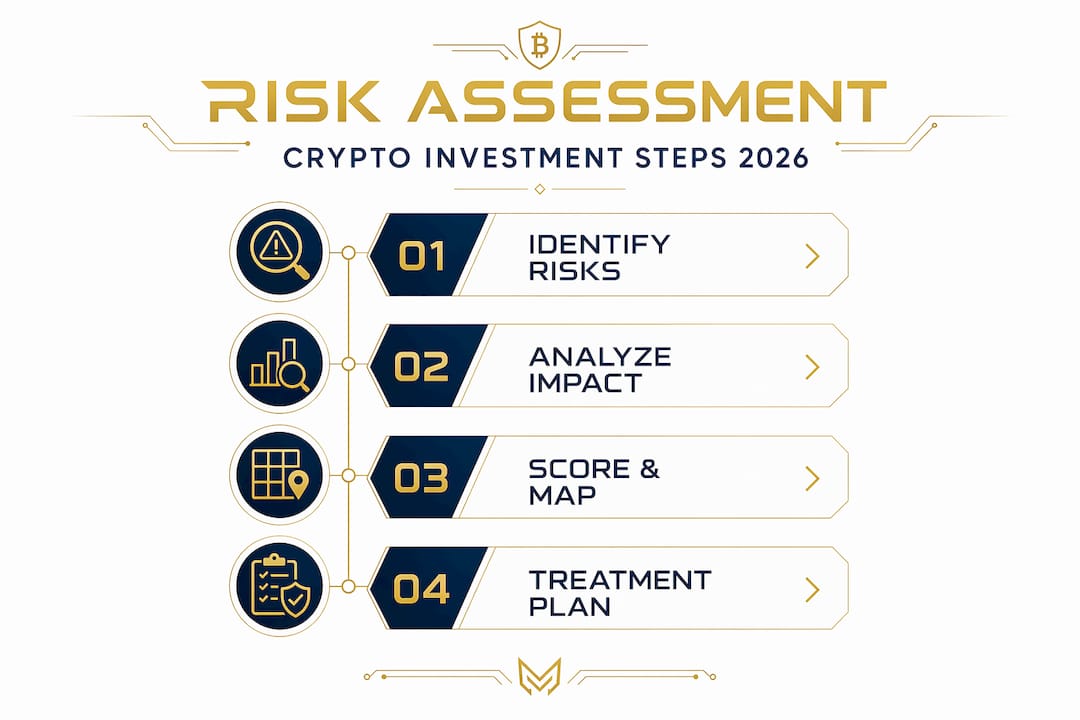
This is where the real work happens. The four-step risk framework of identify, analyze, score, and treat gives you a repeatable process you can apply to any asset.
Step 1: Identify all relevant risks
List every risk that could affect your investment. Don't filter yet. For a given token, your list might include: price collapse, exchange hack, regulatory ban in your jurisdiction, smart contract exploit, project team abandonment, and low liquidity making exit costly. Cryptocurrency lacks FDIC or SIPC protection, which means any of these risks can result in total loss with no safety net.
Also identify risks specific to the asset type. For a stablecoin, add reserve transparency and redemption mechanism risk. For a utility token built on a new protocol, add smart contract risk and governance attack risk. For any token currently under regulatory scrutiny, add securities reclassification risk.
Step 2: Analyze likelihood and impact
For each risk you've identified, estimate two things: how likely is this to occur in your investment timeframe, and how severe would the impact be if it did? Use a simple 1 to 5 scale for each. A regulatory ban might be low likelihood but catastrophic impact. A short-term price drop might be high likelihood but manageable impact if your position size is appropriate.

The SEC's March 2026 guidance on crypto asset classification adds a concrete input here. If the token you're evaluating has characteristics of a security, your regulatory risk score should reflect that classification risk explicitly. How the token is marketed and by whom matters under this guidance.
Step 3: Assign risk scores and build your heat map
Multiply your likelihood score by your impact score for each risk. A score of 4 likelihood times 5 impact equals 20, which sits in your high-risk zone. Plot these on a heat map to see your full risk picture at a glance. Any score above 15 deserves a documented mitigation plan before you invest.
Pro Tip: Don't score risks in isolation. Compare your scores across the six categories to see where risk is concentrated. If five out of six categories score high for a single asset, that's a signal the overall risk profile is too heavy regardless of potential upside.
Step 4: Develop treatment plans
For each high-scoring risk, decide how you'll handle it. Diversification across multiple assets reduces concentration risk. Using a hardware wallet or a regulated custodian reduces custody risk. Setting a position size limit reduces the damage any single failure can cause. Monitoring regulatory news reduces the chance that a rule change catches you off guard.
Document your treatment plans. Writing them down forces clarity and gives you a reference point when market pressure tempts you to abandon your framework.
Common pitfalls in crypto risk assessment
Knowing the steps is one thing. Avoiding the mistakes that undermine those steps is another.
- Ignoring custody and platform risk: Operational and custody failures cause more retail losses than market volatility. Exchange insolvencies, withdrawal freezes, and hacks are not rare events. Treat the platform you use as a risk factor, not a neutral tool.
- Fixating on price history: Volatility analysis tells you how bumpy the ride has been. It tells you almost nothing about regulatory risk, smart contract quality, or whether the team can be trusted.
- Skipping liquidity checks: Illiquid altcoins can look attractive on paper but trap you when you try to exit. Check daily trading volume and the depth of the order book before buying, not after.
- Treating regulatory risk as static: The FCA's transition timeline toward full FSMA regulation by October 2027 is one example of how platform compliance risk evolves. Regulatory environments in the US, EU, and UK are all in active transition. A risk score you assigned in January may be wrong by July.
- Missing concentration risk: Check on-chain data for wallet distribution. If 10 wallets hold 60% of the supply, a coordinated sell-off can crater the price before you can react.
Pro Tip: Before investing in any token, run a quick custody audit on yourself. Ask: if this exchange went offline tomorrow, could I recover my assets? If the answer is no, that's a risk you haven't treated yet.
How to monitor your crypto risk profile over time
A risk assessment is not a one-time event. Crypto markets move fast, and evaluating likelihood and impact before acting only improves decision quality when you repeat the process regularly.
Using composite risk tools
Single-metric indicators like price or volume miss too much. The Cryptocurrency Composite Risk Index blends market price data, network fundamentals, and sentiment signals to predict systemic risk events before they fully materialize. Tools that combine multiple data streams give you earlier warning than any single chart can.
When to reassess your risk treatment plans
Set a calendar reminder to review your full risk assessment at least quarterly. Trigger an immediate reassessment when any of these occur:
- A regulatory announcement affects your asset's classification
- A major exchange or protocol in your ecosystem experiences a security incident
- Your position size changes significantly relative to your total portfolio
- The token's development activity drops sharply or key team members leave
- Trading volume falls below your original liquidity threshold
Staying current on platform and custody risk
Review the custody method for each asset you hold at least twice a year. Check whether the exchange or custodian you use has obtained or maintained relevant regulatory registrations. Verify that withdrawal processes still function as expected. These checks take less than an hour and can prevent the kind of loss that no market recovery can fix.
My honest take on crypto risk assessment
I've watched a lot of investors spend hours analyzing price charts and almost no time thinking about where their tokens actually live. In my experience, that's the single biggest gap in how most people approach cryptocurrency investment risk. Platform risk is the quiet killer. Exchange failures don't announce themselves in advance.
What I've also found is that regulatory risk gets treated like a background concern rather than a live variable. After the SEC's 2026 guidance, that approach is genuinely dangerous. Token classification can shift, and with it your legal exposure. I think the investors who will navigate the next few years well are the ones who treat regulatory monitoring as a weekly habit, not an annual check-in.
The other thing I'd push back on is the idea that a single risk score per asset is enough. Separating asset-specific risk from protocol risk matters because they respond to completely different triggers. A token can have strong fundamentals and still sit on a vulnerable protocol. Scoring them together hides that distinction.
Finally, the psychological side of volatility is real and underrated. Having a documented risk framework doesn't just improve your decisions. It gives you something to hold onto when prices drop 40% in a week and every instinct says to sell. The framework is your anchor when emotion wants to be the decision-maker.
— Jesse
Start your crypto journey with full risk awareness
If you're considering participating in a token presale, doing your homework on risk disclosures is non-negotiable. Mokzero's $MOKZ token operates on the Polygon ecosystem and is designed with transparency at its core, giving you real-time updates and clear allocation processes from day one.
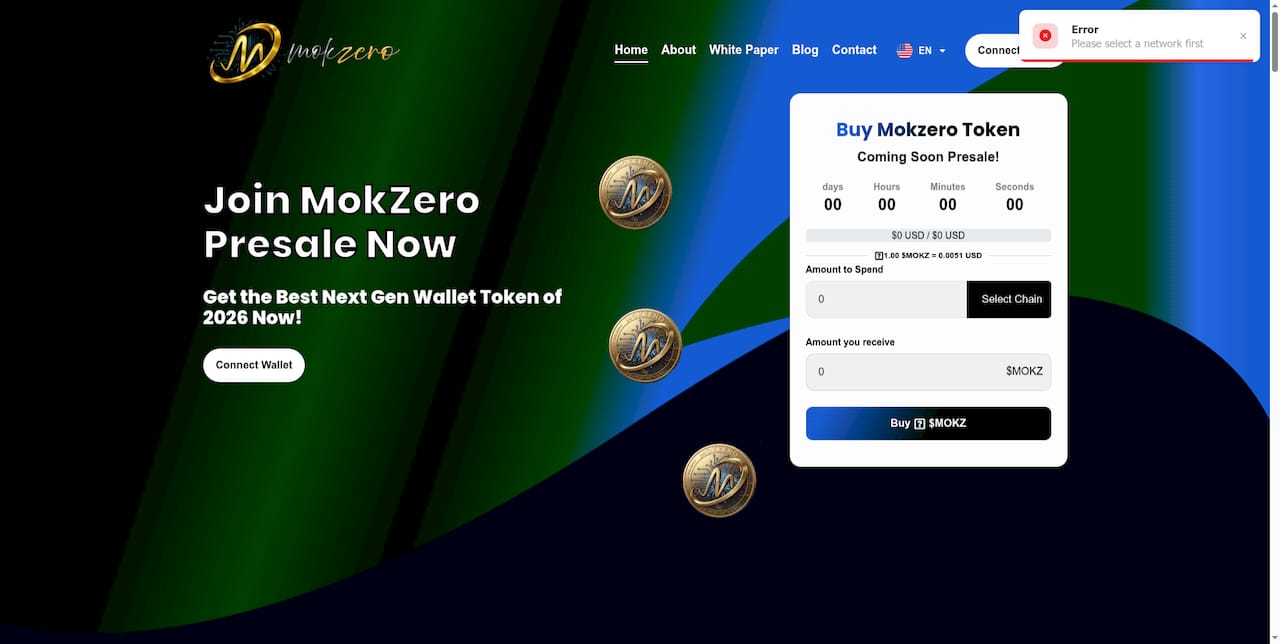
Before you invest, read through the Mokzero risk warning page carefully. It covers software vulnerabilities, smart contract risks, and the specific disclosures you need to evaluate before committing capital. Then, when you're ready to explore the presale itself, visit Mokzero's presale page to see current token availability and pricing. Understanding the risks is the first step. Taking that step before you invest is what separates informed participation from speculation.
FAQ
What is a crypto investment risk assessment?
A crypto investment risk assessment is a structured process for identifying, scoring, and planning responses to the specific risks that affect a cryptocurrency investment, covering market, regulatory, technical, and custody dimensions.
How do I assess crypto risks for different token types?
Each token category carries distinct risks. Stablecoins require reserve and redemption analysis, utility tokens need smart contract audits, and payment tokens demand regulatory and liquidity evaluation.
What does the 2026 SEC guidance mean for my risk assessment?
The SEC's March 2026 guidance clarifies how certain crypto assets are classified under federal securities law, which directly affects the regulatory risk score you should assign to any token with security-like characteristics.
How often should I update my crypto portfolio risk analysis?
Review your full risk assessment at least once per quarter, and trigger an immediate review after any major regulatory announcement, security incident, or significant change in your position size.
Are crypto investments protected if an exchange fails?
No. Crypto investments lack FDIC and SIPC protection, meaning exchange failures or hacks can result in total loss of principal with no government-backed recovery mechanism.