

Most people assume blockchain verification is just a simple checksum. Run a hash, confirm a match, done. The reality is far more layered. Blockchain verification is a multi-stage process where independent nodes validate cryptographic signatures, check balances, confirm no double-spending, and then reach distributed consensus before any transaction becomes permanent. Understanding what is blockchain verification at this level matters enormously if you are a business processing payments, issuing credentials, or buying digital assets. It is the mechanism that replaces the need for a bank, notary, or any trusted third party.
Table of Contents
- Key Takeaways
- What blockchain verification actually is
- Types of blockchain verification methods
- How individuals and businesses verify transactions
- Challenges in blockchain verification
- My take on what blockchain verification really means
- Verify with confidence using Mokzero
- FAQ
Key Takeaways
| Point | Details |
|---|---|
| Verification is multi-stage | Transactions pass through signature checks, balance validation, and consensus before becoming final. |
| Consensus method shapes trust | Proof of Work and Proof of Stake differ in energy use, speed, and how they secure the network. |
| Two distinct verification points | Nodes validate locally first; consensus confirms finality on-chain, and these are not the same event. |
| Practical tools exist for anyone | Block explorers and full nodes let individuals and businesses verify transactions without trusting a wallet UI. |
| Hash comparison protects documents | Enterprises store document hashes on-chain to enable instant, tamper-proof credential verification. |
What blockchain verification actually is
Blockchain verification is the distributed process by which a network of independent computers, called nodes, confirms that a transaction is legitimate before it becomes a permanent part of the chain. No single authority decides. The network decides collectively, and that distinction is what makes it trustless.
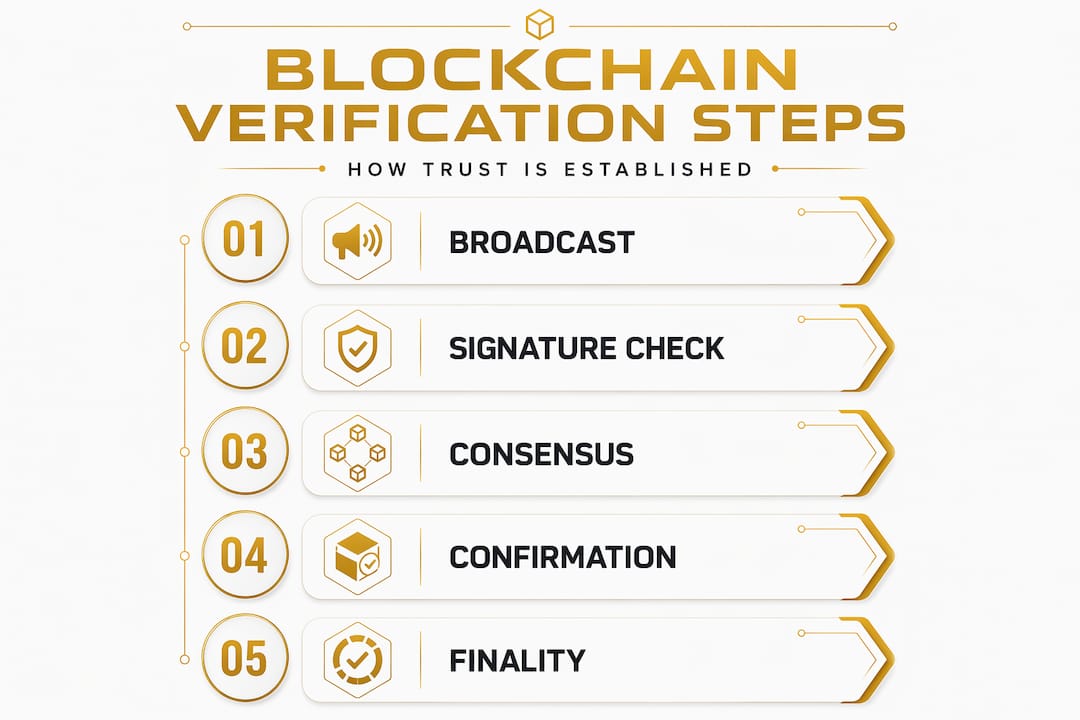
Here is how the blockchain verification process works, step by step:
- Transaction broadcast. You initiate a transaction. Your wallet signs it with your private key and broadcasts it to the peer-to-peer network. Every node that receives it adds it to a waiting area called the mempool.
- Node-level validation. Each node independently checks three things: that your digital signature is valid, that you have enough balance to cover the transaction, and that you are not trying to spend the same funds twice.
- Block assembly. Miners or validators gather verified transactions from the mempool and bundle them into a candidate block. Each block contains a cryptographic hash of the previous block, which is what creates the "chain."
- Consensus. The network runs a consensus mechanism to agree on which block gets added next. This is where transaction ordering and finality are determined.
- Confirmation and immutability. Once a block is accepted, the transaction inside it receives one confirmation. Each subsequent block added on top adds another confirmation, making the transaction progressively harder to reverse.
Pro Tip: Do not treat a transaction as final after just one confirmation. For high-value transfers, wait for at least six confirmations on Bitcoin. Each additional block makes altering the record exponentially more expensive for an attacker.
The layered trust model here is worth appreciating. Cryptographic signatures prove you control the private key. Consensus mechanisms prove the transaction is valid and ordered correctly. Together, they eliminate the need for a bank to vouch for you.
Types of blockchain verification methods
Not all blockchains verify transactions the same way. The consensus mechanism a network uses defines its security model, energy footprint, and how much you can trust its finality. Here are the primary types of blockchain verification methods:
| Method | How it works | Energy use | Speed | Best for |
|---|---|---|---|---|
| Proof of Work (PoW) | Miners compete to solve computational puzzles | Very high | Slower | Maximum decentralization |
| Proof of Stake (PoS) | Validators are chosen based on staked collateral | Low | Faster | Scalable, eco-friendly networks |
| Delegated PoS | Token holders vote for delegates who validate | Low | Very fast | High-throughput applications |
| Permissioned consensus | Known participants validate in a controlled network | Minimal | Very fast | Enterprise and private chains |
Proof of Work is the original blockchain validation technique. Computational effort validates blocks, and any block that does not meet the network's difficulty target gets rejected outright. The security model is economic: attacking the network costs more than any potential gain. Bitcoin uses this approach.
Proof of Stake replaces computation with collateral. Validators lock up cryptocurrency as a stake, and the protocol selects them to propose and attest to blocks. If they try to cheat, they lose their stake. Ethereum moved to this model in 2022, cutting its energy use by over 99%.
Key tradeoffs to keep in mind:
- PoW offers the strongest proven security but consumes significant energy and processes transactions slowly.
- PoS is faster and greener but introduces different trust assumptions around validator concentration.
- Permissioned blockchains sacrifice decentralization for speed, making them practical for enterprise supply chains and regulated industries.
- Immutability across all models prevents retroactive record changes, but the strength of that guarantee depends on how distributed the validator set actually is.
The consensus method you interact with shapes how much you need to understand before trusting a transaction as final.
How individuals and businesses verify transactions
Understanding the blockchain verification process in theory is one thing. Knowing how to actually check a transaction yourself is what builds real confidence in the system.
Block explorers are the most accessible tool. Every public blockchain has at least one. You paste your transaction ID (TXID) into a block explorer and see the full record: sender, recipient, amount, block number, and confirmation count. Users can verify transactions independently without trusting any wallet interface or exchange. This matters because a wallet UI can display incorrect or delayed information.

Running a full node is the gold standard for self-verification. A full node downloads the entire blockchain and validates every transaction against the protocol rules itself. Businesses that process large volumes of crypto payments often run their own nodes precisely because they do not want to rely on a third-party API that could go down or return stale data.
Credential and certificate verification is a growing enterprise use case. The process works like this:
- A university or certification body generates a credential document.
- A cryptographic hash of that document gets written to the blockchain.
- Anyone who receives the credential can hash the document themselves and compare it against the blockchain record.
- If the hashes match, the document is authentic. If they do not, it has been altered.
This approach means anyone can verify certificates without needing an account, an app, or permission from the issuing institution. The blockchain acts as a public notary that never sleeps.
The benefits here go beyond convenience. Fraud prevention is concrete. Auditing becomes automatic. Any stakeholder, whether a regulator, employer, or customer, can confirm the authenticity of a record without calling anyone.
Pro Tip: If you are a business accepting crypto payments, always verify the TXID on a block explorer before releasing goods or services. Wallet confirmations can lag, and a transaction that looks confirmed in a UI may still be unconfirmed on-chain.
Challenges in blockchain verification
Blockchain verification is not a solved problem. Real-world implementations face genuine performance and security challenges that anyone building on or transacting through a blockchain should understand.
The most important nuance is that verification happens twice. First, nodes validate a transaction locally before relaying it. Second, the consensus process confirms its final inclusion in the chain. These are distinct events. A transaction can pass local validation and sit in the mempool for hours before it gets picked up by a miner or validator. During that window, it is valid but not final. Treating mempool acceptance as confirmation is a common and costly mistake.
Scalability is the other pressure point. As networks grow, the number of transactions requiring verification increases, and not all nodes have equal resources. Resource-weighted verifier selection is an emerging approach that allocates verification tasks based on a node's computational and network capacity, reducing latency without sacrificing decentralization. Research published in 2026 confirms that weighted selection mechanisms can meaningfully improve verification throughput across decentralized networks.
Attack vectors also deserve attention. A 51% attack, where a single entity controls the majority of mining or staking power, could theoretically rewrite recent transaction history. This is why distributed node consensus matters so much. The more decentralized the validator set, the more expensive and impractical any attack becomes. Permissioned chains, while faster, concentrate trust in a smaller group and therefore carry a different risk profile.
Evolving Layer 2 protocols and zero-knowledge proof systems are addressing many of these challenges by moving some verification off the main chain while preserving cryptographic guarantees. These are not perfect solutions yet, but they represent the direction the industry is moving.
My take on what blockchain verification really means
I have spent years watching businesses approach blockchain with one of two attitudes: either they treat it as magic that solves all trust problems automatically, or they dismiss it as overhyped because they do not understand how verification actually works. Both positions are wrong, and both cost money.
What I have learned is that blockchain verification is a genuine paradigm shift in how trust gets established. Not because the technology is flawless, but because it moves the source of trust from institutions to math. When a transaction clears on a public blockchain, you do not need to trust the platform, the counterparty, or the payment processor. You need to trust the protocol, and you can verify the protocol yourself.
The misunderstanding I see most often is businesses assuming that "on the blockchain" automatically means "verified and final." It does not. As I explained earlier, mempool acceptance and on-chain finality are different states. I have seen companies release products after seeing a single unconfirmed transaction, and that is an avoidable mistake.
What I watch closely now is the convergence of zero-knowledge proofs with mainstream verification workflows. The ability to prove something is true without revealing the underlying data is going to change how credential verification, identity, and private transactions work. Businesses that understand verification at the protocol level today will be far better positioned to use those tools when they mature.
— Jesse
Verify with confidence using Mokzero

If you are exploring blockchain-based token purchases, the verification principles covered in this article apply directly to how Mokzero operates. The Mokzero $MOKZ token presale on Polygon uses blockchain verification at every step, giving buyers real-time confirmation of their token allocation without writing a single line of code. Every transaction is transparent and auditable on-chain, so you are never relying on a dashboard alone to confirm your purchase. Mokzero's zero-code approach means you get the security benefits of blockchain verification without needing to run a node or parse a block explorer yourself. Before participating in any token presale, review the risk disclosure to understand what is involved.
FAQ
What is blockchain verification in simple terms?
Blockchain verification is the process by which a network of independent computers confirms that a transaction is valid and records it permanently. No single party controls the outcome. The network reaches consensus through cryptographic rules.
How does blockchain verification work step by step?
A transaction is broadcast to the network, validated by nodes for signature validity, balance, and double-spend checks, bundled into a block, and then accepted through a consensus mechanism. Each block added after it adds another layer of confirmation.
What are the main types of blockchain verification methods?
The primary methods are Proof of Work, Proof of Stake, Delegated Proof of Stake, and permissioned consensus. Each differs in energy use, speed, and how trust is distributed across the network.
Why does blockchain verification matter for businesses?
Blockchain verification removes the need for intermediaries in transaction validation, reduces fraud risk, and creates an auditable record that any authorized party can check independently. This is especially valuable for payments, credential issuance, and supply chain tracking.
Can I verify a blockchain transaction myself?
Yes. You can use a block explorer by entering your transaction ID to see its status, block number, and confirmation count. For higher assurance, running a full node lets you validate transactions directly against the protocol rules without relying on any third-party service.